
UHERO Insights
Would we be in a recession without AI?
Investment, imports, and the stock-market wealth effect
INSIGHTS ARE PRELIMINARY MATERIALS CIRCULATED TO STIMULATE DISCUSSION AND CRITICAL COMMENT.
The findings and recommendations are those of the author(s) and do not reflect the views or official positions of UHERO, the University of Hawai’i, or any funding or supporting organization.
Gangnes, B. (2026). Would we be in a recession without AI? Investment, imports, and the stock-market wealth effect. UHERO. https://uhero.hawaii.edu/would-we-be-in-a-recession-without-ai/
Gangnes, Byron. "Would we be in a recession without AI? Investment, imports, and the stock-market wealth effect." UHERO, 21 October 2026, https://uhero.hawaii.edu/would-we-be-in-a-recession-without-ai/.
Byron Gangnes. "Would we be in a recession without AI? Investment, imports, and the stock-market wealth effect." UHERO, October 21, 2026. https://uhero.hawaii.edu/would-we-be-in-a-recession-without-ai/.
@misc{gangnes2026,
  author  = {Byron Gangnes},
  title   = {Would we be in a recession without AI? Investment, imports, and the stock-market wealth effect},
  year    = {2026},
  month   = {October},
  howpublished = {\url{https://uhero.hawaii.edu/would-we-be-in-a-recession-without-ai/}},
  note        = {UHERO},
  url     = {https://uhero.hawaii.edu/would-we-be-in-a-recession-without-ai/}
}“Without the AI boom, we probably would be in a recession.”
I keep hearing this. Is it true?
The AI infrastructure buildout has partly offset weak construction and caused a boom in computer equipment and software investment. And the AI-powered surge in the stock market has raised household wealth and therefore consumer spending. How much, and where would we be without this?
Construction represents a small part of the AI buildout. Real spending on data centers has risen from about $11.5 billion per year at the start of 2023 to about $59.5 billion recently, a dramatic rise in percentage terms but only about $48 billion in dollar terms. (All these values are in real terms, chained 2017 dollars.) Small potatoes in a $24 trillion economy.

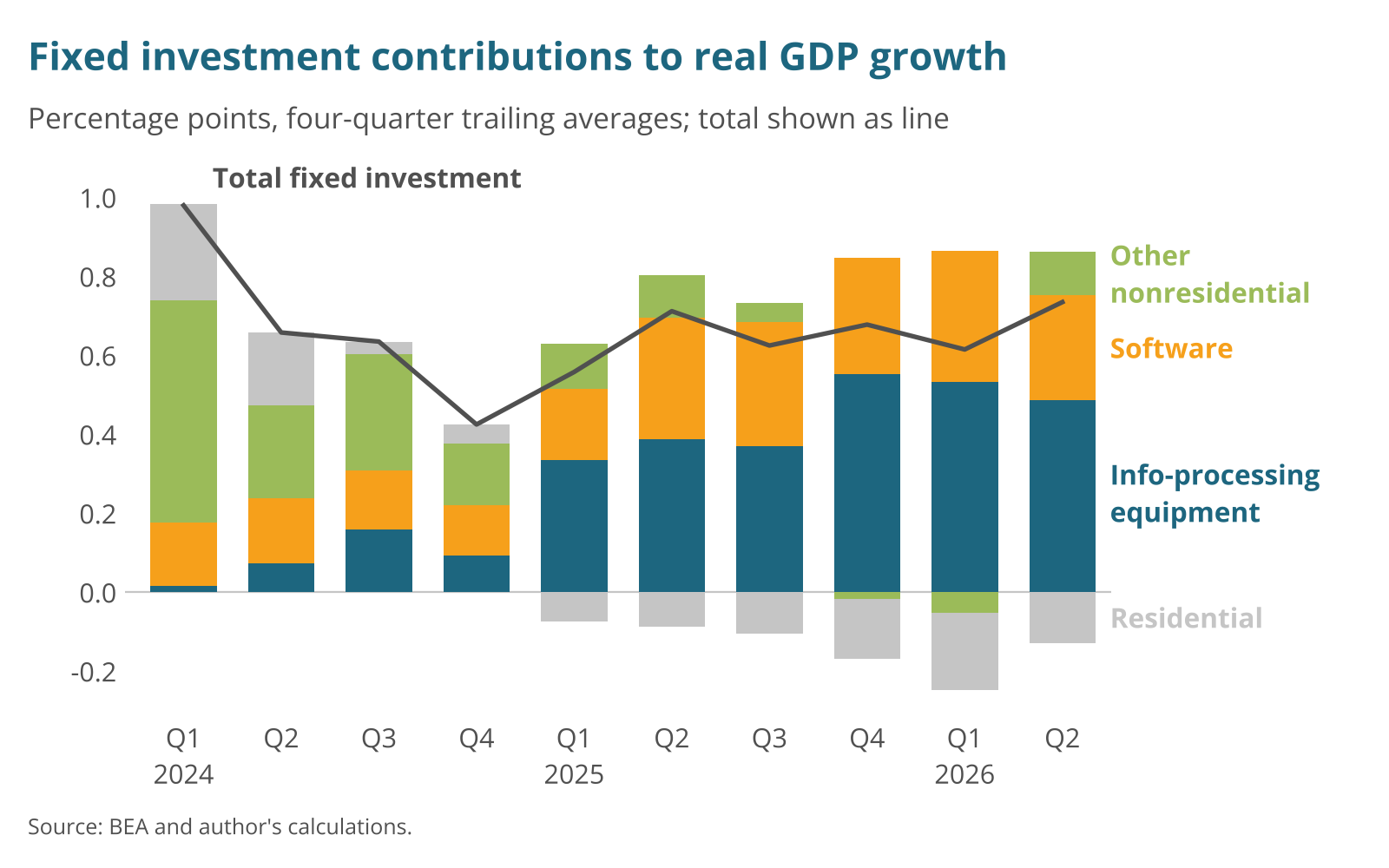
Increased spending on information processing equipment and software has been much larger, this year running about half a trillion dollars higher than it was in 2022. At its current rate, this looks to be contributing about three-quarters of a percentage point to real GDP growth these days. That’s baking-sized potatoes.
US households’ AI-related stock market wealth has risen by about $19.5 trillion since the fourth quarter of 2022, just under $15 trillion in 2017 dollars.[1] Estimates of how much consumers spend out of stock market wealth typically range from about 2 to 4 cents on the dollar, although one recent Fed estimate is lower.[2] A 2 to 4 cent response, with spending adjusting over about a year, implies that AI-wealth-driven spending has accounted for $255–509 billion of the roughly $1.5 trillion real consumer spending increase since the end of 2022, with some likely still in the pipeline. Those are pretty big spuds, too.
So one might think that without the AI buildout we would be in a recession now.
But we need to be careful here. First, the half to two-thirds of AI-related investment that is physical equipment is largely imported, so it adds little to domestic output.[3] For software, available data do not identify how much of its roughly 0.3 percentage point contribution over the past year is AI-related. Because software was already adding about 0.2 percentage points to annual growth before ChatGPT, I somewhat generously assume that the AI-related contribution lies between 0.1 and 0.2 points.

Second, there is evidence that AI-related investment has crowded out a significant amount of other fixed investment, which has seen no growth since early 2025. Non-AI construction has fallen significantly. This crowding out likely reflects AI contributing to higher interest rates, driving up the prices of computer chips and peripherals, and perhaps competing for scarce electricity or water.
The bottom line is that the NET contribution to US growth of AI-related construction, equipment, and software investment spending is limited, no more than about a quarter of a percentage point.
That leaves the wealth effect on consumer spending as the likeliest economic boost from the AI buildout. My $255–509 billion estimated boost to spending represents 17–34% of the total rise in real consumer spending over the past three and a half years. In the absence of this additional wealth-driven spending, consumption growth would have been between roughly half a point and a little over one percentage point weaker by the second quarter of 2026. The consumer’s contribution to real GDP growth would have been 0.4–0.8 percentage points smaller than it’s actually been.

Combine this with up to a quarter of a percentage point drag from forgone AI-related construction, equipment, and software investment, and US economic growth would have slowed more significantly than it has over the past year, with AI’s absence subtracting a little over a half percentage point to just over one point. At the high end of this range, US growth would have been about half as strong as the actual 2.2% rise.[4]

So we would likely not be in a recession, but possibly not too far above one either.[5]
What if the AI stock surge were to reverse? Here, I am more concerned, since an abrupt bursting of an AI bubble could very rapidly reduce wealth-driven spending and perhaps call a halt to planned AI investment. It would also be disruptive to household and business confidence, reinforcing a spending pullback. And a rapid repricing of AI risk might cause further turmoil in credit markets, driving borrowing costs higher.
Whether the mid-October chip sell-off was the beginning of such a dynamic remains to be seen. But were this scenario to play out, the combined effects could very well push the US economy into recession.
Mashed potatoes, anyone?
Thanks to Carl Bonham and Peter Fuleky for helpful comments. An AI tool was used as a research assistant in preparing this work.
[1] This is a very difficult number to estimate. I start with the Fed’s measure of household stock market wealth held directly and through mutual funds and retirement accounts. I exclude closely held private companies, whose estimated values are derived from public-market valuations but are much less likely to drive consumer spending. That leaves a gain of about $28 trillion from the end of 2022 through the second quarter of 2026. For S&P 500 companies, I assume 75% of the gain is AI-related, based on J.P. Morgan’s estimate that AI-related stocks accounted for 75% of S&P 500 returns since ChatGPT’s launch in late 2022 (Michael Cembalest, “The Blob: Capital, China, Chips, Chicago and Chilliwack,” Eye on the Market, J.P. Morgan Asset & Wealth Management, Sept. 2025). For smaller US companies and foreign stocks, which have less AI exposure, I assume 50%. This assumption follows in part from the smaller rise in non-US stock markets, which gained about two-thirds as much as the S&P 500 over this period.
[2] Earlier research suggested a value of about 3 cents of added spending per year for each dollar of stock market wealth, with some support for higher and lower values (James Poterba, “Stock Market Wealth and Consumption,” Journal of Economic Perspectives, 2000). Recent estimates fall in this range. Gabriel Chodorow-Reich, Plamen Nenov, and Alp Simsek estimate about 3 cents (“Stock Market Wealth and the Real Economy: A Local Labor Market Approach,” American Economic Review, 2021). Oxford Economics estimates that a 1% rise in stock wealth raises spending by 0.07%, or about 4 cents per dollar (“US Wealth Effects Are a Major Swing Factor for the Consumer Outlook,” Sept. 9, 2026). An outlier on the low side, Federal Reserve Board economists estimate only slightly above 1 cent, emphasizing the concentration of stock wealth among high-income households with low spending propensities (Samara Beach, William Gamber, and Patrick Moran, “Wealth Heterogeneity and Consumer Spending,” FEDS Notes, Aug. 5, 2025). I use 2 to 4 cents and assume spending fully adjusts within four quarters, faster than in a number of studies. At 1 cent, the wealth effect would add only about 0.2 percentage point to growth, and the total AI contribution would be about 0.35 to 0.45 points.
[3] AI hardware imports are approximated from Census Bureau trade data (USITC DataWeb) for servers and other computer processing units, storage units, computer parts, and processor and memory chips (HS codes 8471.50, 8471.70, 8473.30, 8542.31, and 8542.32). I seasonally adjust the monthly data (Census X-13), scale them up by about 5% to match BEA’s trade-account basis, and convert them to real terms with the BLS import price index for computers, peripherals, and semiconductors. Because some imported hardware is re-exported, I subtract BEA exports of computers, peripherals, and parts. The mapping is approximate: some of these imports end up in consumer products, and some AI equipment arrives under other codes.
[4] Comparison with other studies: Tallies of AI-related investment that don’t net out imports find large effects: 0.97 points, or 39% of growth, in the first three quarters of 2025, including R&D (Hannah Rubinton and Bontu Ankit Patro, “Tracking AI’s Contribution to GDP Growth,” Federal Reserve Bank of St. Louis, Jan. 12, 2026), and 92% of growth in the first half of 2025 (Jason Furman, Harvard, post on X, Sept. 27, 2025). Net of imports, estimates are far smaller: “basically zero” for 2025 (Jan Hatzius, Goldman Sachs, in TechRadar, Feb. 25, 2026), and an average of about 0.6 points over the four quarters to 2026Q1 (Paul Soto, Mason Thieu, and Jeffrey Allen, “The AI Buildout and the Economy,” FEDS Notes, Federal Reserve Board, July 17, 2026, Figure 7). My net investment estimate of 0.15 to 0.25 points falls between the two; the Fed figure counts all software investment and nets out only computer imports. Among the few studies that include the wealth effect, total effects are moderate: about 0.5 points in 2025, with 0.34 points from consumer spending (Mark Zandi et al., “The Macroeconomic Consequences of AI,” Moody’s Analytics, Feb. 2026), and about a third of 2026 growth, with a wealth effect of about 0.4 points (James Knightley, ING, “How much is AI contributing to US economic growth?” Aug. 19, 2026). The low end of my range is close to these; my high end is larger, reflecting a bigger assumed spending response to stock gains and, to a lesser extent, a faster one.
[5] Note that I am focused here only on the past three and a half years, so I do not assume much of a boost to growth from AI adoption. That may well be very significant in coming years.